
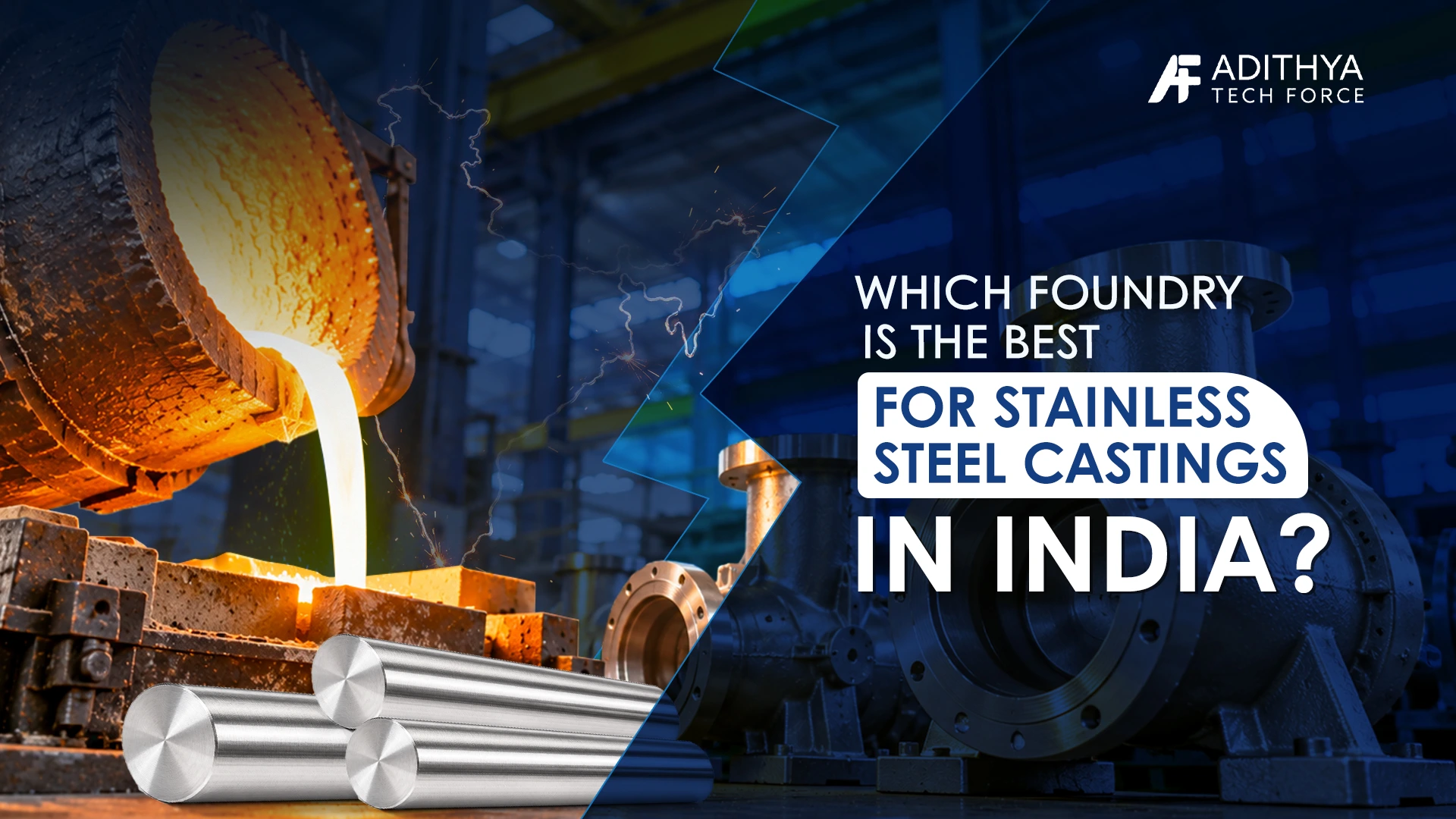
- The best stainless steel castings in India come from foundries that guarantee grade, heat treatment, and test results.
- Rust spots and pitting typically begin there, rather than at the time of pouring.
- Five checks cover it: grade, heat treatment, testing, surface finish, and size and capacity.
- CF8M, CF3M, or duplex? Tell the foundry what the part will touch.
- Shortlisting a stainless steel foundry in Coimbatore? Walk the plant and ask for the heat treatment records.
How to Choose a Foundry for Stainless Steel Castings in India
Picture a batch of pump bodies sent to a dairy plant. Three weeks later, rust spots show up, and the buyer asks the question nobody wants to hear: “Is this really stainless?”
Usually the metal itself is fine. The grade, the heat treatment, and the surface finish all have to be right, and any one of them can quietly go wrong. Five questions at the quoting stage catch most of it.
CHECK OUR RANGE – Steel Casting Services
Five Mistakes Buyers Make When Choosing a Stainless Steel Foundry
| Mistake | Why It Hurts | The Fix |
| Asking only for “304” or “316” | Cast grades have their own names, and the wrong one may not suit the job | Ask for the ASTM A351 grade and say what the part will touch |
| Skipping heat treatment details | Without solution annealing, castings lose corrosion resistance | Ask for the heat treatment cycle and records |
| Not asking for a test certificate | Chemistry can’t be checked later | Get a material test certificate with every batch |
| Ignoring surface handling | Iron picked up during grinding or blasting can show as rust spots | Ask how stainless is cleaned and finished |
| Not matching size to the plant | Your part may fall outside its comfortable range | Ask for the weight range and monthly capacity |
Grade Range
The saying “316” doesn’t tell the full story. When casting, CF8 is approximately the cast version of 304 and CF8M of 316, and CF3M is the low-carbon version that is more resistant to intergranular corrosion.
ASTM A351 grades offered by Adithya Tech Force are CF8, CF8M, CF3, CF3M, CF8C and duplex and super duplex per ASTM A995. Typical applications for stainless castings are food processing and pharmaceutical and chemical plants, where they are used as valves, pumps and heat exchangers.
Heat Treatment
This is the missed step by buyers. Solution annealing is specified by ASTM A351; the temperature is to be raised to a minimum of 1,040°C followed by rapid cooling in water. It dissolves carbides and brings the corrosion resistance back. Miss it and a casting can come out perfect and fail to hold up in service.
There are 5 electric heat treatment furnaces (3 to 5 MT), water and air quenching systems, and time-temperature recorder are installed at the foundry. Request the recorded cycle along with your batch.
Testing
A good test certificate lists chemistry and mechanical results, plus ferrite content where it matters. The lab here is NABL approved, so the numbers come from the same plant that made the part.
Surface Finishing
Not always is the rust to be blamed on the metal. Iron may be left by the tools or abrasives as a result of the grinding or blasting operation if they came in contact with the carbon steel first. Inquire about the method used by the foundry to keep stainless apart and if pickling or passivation can be provided for your application.
Size and Capacity
Single pieces run from a few grams to 3,000 kg, with steel casting capacity of 400 tons a month and CNC machining for finished parts.
When Stainless Is Overkill
If a part won’t be exposed to moisture or chemicals, carbon steel in WCB or WCC may be enough, and it costs less. Our guide to the types of steel castings and their uses helps you compare.
Why a Stainless Steel Foundry in Coimbatore Is Worth Visiting
The castings made from stainless steel are one of the largest applications in Coimbatore, India, for pumps, valves, and engineering shops. A stainless steel foundry Coimbatore that buyers can visit lets you see the heat treatment furnaces, ask for a sample test certificate, and meet the people who will handle your order.
Final Thoughts
Stainless castings go into places where failure is expensive. That is why the paperwork matters almost as much as the price.
So, what is the best way to get stainless steel castings in India? Ask the foundry for the grade it will use, the heat treatment record, and a test certificate with each batch. If it responds promptly and with a written response, you’re headed in the right direction. Otherwise, continue searching.
Adithya Tech Force works from Coimbatore with the ASTM A351 stainless range, duplex grades, an NABL-approved lab, and heat treatment and machining in the same plant. Send us your drawing along with the grade you have in mind, and we will go through it with you.
Frequently Asked Questions (FAQs)
- Which one should I select, CF8M or CF3M?
The common cast type of CF8M is 316. CF3M has a lower carbon concentration, which is beneficial for resisting intergranular corrosion, and is suitable for welded parts or heat-exposed parts. Describe the conditions for the service and the foundry will advise.
- Why is my stainless casting stick sticking to a magnet?
Cast Stainless contains a small amount of ferrite and has a slight magnetism, which is normal. For jobs requiring extremely low magnetism, inquire for the ferrite figure on the test certificate.
- What do I need to say before I order?
The grade under ASTM A351 or A995, the heat treatment record, a test certificate, and the required surface finish. The review process is quicker when the drawing is sent.