
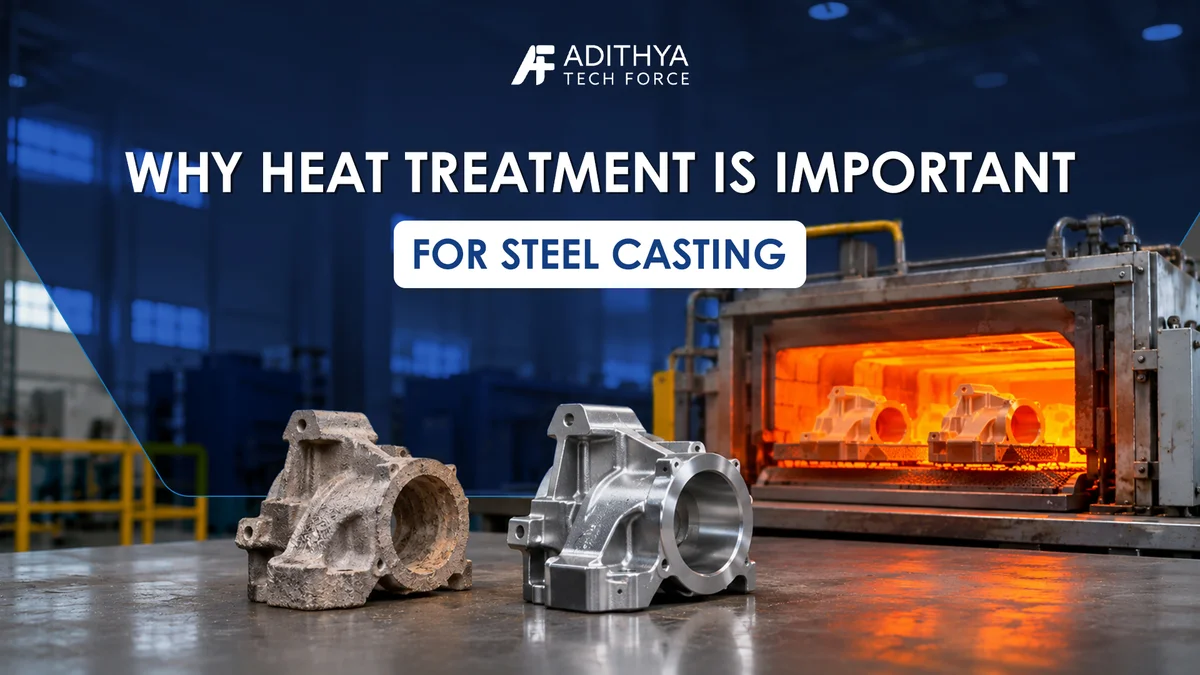
- Heat treatment of steel castings fixes the stressed, uneven structure a casting has when it leaves the mould.
- It sets the strength, toughness, and hardness the part needs, and helps it keep its shape.
- Four routes cover most jobs: annealing, normalising, quench and temper, and stress relieving.
- Skip it or rush it, and steel castings crack, warp, or wear out early.
- Before you order, ask for the heat treatment record and a test certificate.
What Is Heat Treatment of Steel Castings, and Why Does It Matter?
Picture a pump casing that passes visual inspection and ships on time. Six months into service, a hairline crack appears near the flange. The chemistry on the certificate was right, and the dimensions were fine. What nobody checked was what happened to the steel inside.
For example, steel castings cool unevenly in the mould, which creates locked-in stress and creates an irregular grain. The fix is to heat and cool in a controlled manner: heating and cooling to a controlled temperature, so that the internal metal is what the drawing wants.
CHECK OUR RANGE – Steel Casting Services
Heat Treatment Routes at a Glance
| Process | What Happens | Why It’s Done |
| Annealing | Heat, then cool very slowly | Softens the steel and relieves stress, so it machines easily |
| Normalising | Heat, then cool in open air | Refines the grain for even strength and toughness |
| Quench and temper | Heat, cool fast in water or oil, then reheat gently | High strength and wear resistance without brittleness |
| Stress relieving | Heat to a lower temperature, cool slowly | Removes locked-in stress, so parts hold their shape |
| Solution annealing | Heat high, quench in water | Restores corrosion resistance in stainless grades |
What the Mould Leaves Behind
As a casting solidifies, its sections cool at different rates. The result is a coarse grain structure and internal stress. Take a valve body for an oil and gas pipeline: its chemistry may match the specification exactly, yet in the as-cast state it can lack the toughness to withstand repeated pressure cycles.
This is why the standards address it directly. ASTM A216 WCB, a common valve grade, must be supplied annealed, normalised, normalised and tempered, or quench and tempered. Heat treatment of steel castings is therefore part of the material specification, not an optional extra.
Strength Without the Shatter
Hardness is not an end in itself. Glass is brittle and breaks. Quenching makes steel strong and hard, and tempering adds back toughness to allow steel to take a knock. It is the balance that is essential for steel castings designed as gears or wear plates.
Holding Its Shape
Stress is transferred in castings. The machine cuts out metal, and that’s where the stress goes, so a piece that is cut perfectly on the CNC may bend a little after cutting. It’s taken away by stress relieving. Self-quenching will either not be possible for large or irregular ware, or will produce a distorted shape; the cycle must therefore be planned and not improvised.
Thick Sections, Thin Sections
A thick wall will take longer to heat up and cool off than a thin wall, and one cycle does not fit all parts. It may have the surface appearance of fine skin, and the inside may not be. The surface may be fine, but the inside may not be, which is why furnace controls are important.
Adithya Tech Force operates 5 Electric Heat treatment Furnaces (3 to 5 MT) with water and air quenching and time-temperature recorders as per API 6A and ASTM A991. Test results come from an NABL-approved chemical and mechanical lab.
ALSO CHECK – Adithya Tech Force Certifications | Stainless Casting Guide
Four Questions to Ask Before You Order
- What cycle will you use for this grade and wall thickness?
- Are the furnaces calibrated, and can I see the time-temperature record for my batch?
- Where are the test bars taken, and do they represent the actual casting?
- Is heat treatment done in-house, or sent out?
Final Thoughts
Heat treatment rarely gets more than one line on a drawing, yet it decides how steel castings behave once they are working.
So the answer to why heat treatment of steel castings matters is simple: it turns a cast shape into a dependable part. Ask for the cycle, the record, and the test results, and you will know the job was done properly.
Adithya Tech Force handles heat treatment, machining, and testing from Coimbatore. Send us your drawing with the grade and working conditions, and we will go through it with you.
Frequently Asked Questions (FAQs)
- Why is heat treatment of steel necessary?
Because steel straight from the mould is rarely ready for service. When not even cooled, a coarse grain and internal stress are left. Controlled heating and cooling eliminates stress, defines strength, hardness, and toughness, and perfects the grain of the part to resist cracking, wear, and warping. - Can heat treatment change the size of a casting?
A little, yes. Quenching can distort large sizes and irregular shapes. This is why there is a machining allowance, and critical dimensions are typically finished after heat treatment. - What test can I use to verify proper heat treating?
Ask to have a time-temperature record and test certificate with tensile, hardness, and impact data, if applicable, for your batch.